TALENT SUPPLY CHAIN MANAGEMENT:
SHAPING THE FUTURE OF WORK
Prepare for the Future of Work by aligning workforce strategy with the rapid changes.
Through advanced tools, AI-driven insights, and expert consultancy, we equip leaders to anticipate change, adapt skillsets, and build future-ready teams.
TSCM: WHAT IS IT?
For decades, organizations have mastered the art of supply chain management for products and services, tracking inventory, forecasting demand, optimizing logistics, and building resilience against disruptions.
Yet when it comes to their most valuable asset, talent, many companies still operate reactively, scrambling to fill gaps only after they appear.
Talent Supply Chain Management (TSCM) changes that paradigm. It applies proven supply chain principles to workforce strategy, creating end-to-end visibility and control over how talent flows through your organization. From the moment you identify a future skill need to the day an employee transitions to their next role or retirement, TSCM ensures you have the right people, with the right capabilities, in the right place, at the right time.
Unlike traditional talent management, which often operates in silos (recruiting does its thing, L&D does theirs, workforce planning works separately), TSCM creates an integrated, predictive system. It's not just about filling today's vacancies; it's about architecting the talent flows that will power your business three, five, or ten years from now.
WHY TSCM MATTERS MORE THAN EVER
The Future of Work is not just a concept; it is a call to action. It marks big changes in how businesses are run, which skills they need, and what kinds of roles they offer. As automation, AI and global supply chain changes reshape the world, being well-prepared will set successful companies apart. We see the Future of Work as a catalyst to help organizations lead the way by turning change into a plan for growth and innovation.

Accelerating Disruption
AI, automation, and technological change are transforming roles faster than ever. The World Economic Forum estimates that 44% of workers' skills will be disrupted by 2027. Traditional reactive hiring can't keep pace; you need a proactive talent supply chain that anticipates and adapts.
Critical Skill Shortages
Over two-thirds of organizations report that talent shortages are their biggest constraint to growth. TSCM helps you identify bottlenecks in your talent pipeline before they become crises, and build alternative sourcing strategies, internal development, partnerships, and contingent talent, to ensure supply meets demand.
Hidden Inefficiencies
How much talent sits idle? How many people are overqualified for their roles? Where are your development programs producing skills you don't actually need? TSCM reveals these inefficiencies, helping you optimize talent ROI and reduce waste in recruitment, development, and retention spending.
Strategic Alignment
Business strategy changes, new markets, mergers, pivots, but workforce plans often lag behind. TSCM creates dynamic alignment, ensuring your talent supply chain can flex and reconfigure as your business strategy evolves, turning workforce agility from aspiration to reality.

TSCM FRAMEWORK
For 30 years, Supply Chain Management (SCM) has given leaders control over the cost, speed, and reliability of their products. What SCOR did for SCM, TSCM does for the workforce.
The framework consists of 8 Strategic Levers (the dials executives turn), 7 Process Steps (the operating rhythm), 6 TSCM Promises and 5 Performance Metrics (the C-suite dashboard).
The promise? Deliver the Right Workers, human and digital, at the Right time, in the Right place, at the Right cost, with the Right capabilities and capacities. As such, Time-to-Skill becomes visible, measurable, and manageable.
Our philosophy: Eat. Sleep. Plan. Repeat: because the world evolves and TSCM never stops.
WHAT ARE THE STRATEGIC LEVERS?
Strategic Levers are the fundamental choices executives make to shape their workforce strategy. Each lever is a spectrum - not binary, but a dial that can be turned to different positions based on context, business needs, and constraints.
Think of them as the steering wheel, accelerator, and brakes of your talent supply chain.
.gif?width=800&height=450&name=8leverssolov2-ezgif.com-video-to-gif-converter%20(1).gif "8leverssolov2-ezgif.com-video-to-gif-converter (1)")
.gif?width=240&height=350&name=Leverv1-ezgif.com-video-to-gif-converter%20(1).gif "Leverv1-ezgif.com-video-to-gif-converter (1)")
GROW ↔ SHRINK
MAKE ↔ ACQUIRE
FIX ↔ FLEX
HUMAN ↔ DIGITAL
NOW ↔ LATER
HERE ↔ THERE
RESHAPE ↔ MAINTAIN
TRANSFORM ↔ OPTIMIZE
Are we expanding or contracting our workforce?
Do we build talent internally or buy it externally?
Do we commit to permanent employees or maintain workforce flexibility?
Where do we deploy humans vs. AI, automation, and digital workers?
Do we optimize for immediate needs or future requirements?
Where do we deploy our workforce geographically?
Do we redesign how work gets done or preserve existing structures?
Are we fundamentally changing the business or improving current operations?
STEP 1:
STEP 2:
STEP 3:
STEP 4:
STEP 5:
STEP 6:
STEP 7:
PLAN
SOURCE
BUILD
DEPLOY
RELEASE
ENABLE
REPEAT
Forecast talent demand and define supply strategies
Identify and attract talent into the pipeline
Develop capabilities in sourced talent
Match developed talent to business needs
Manage talent exits and transitions
Create the infrastructure for the TSC to function
Continuous improvement and cycle reinitiation
.gif?width=800&height=450&name=7processstepsTSCMsolov1-ezgif.com-video-to-gif-converter%20(1).gif "7processstepsTSCMsolov1-ezgif.com-video-to-gif-converter (1)")
WHAT ARE THE PERFORMANCE METRICS?
The 5 Performance Metrics are the executive scoreboard for talent supply chain health. They translate operational complexity into simple, measurable indicators that the C-suite can track, just like they track financial metrics or product supply chain KPIs. These are lagging indicators (did we deliver?) complemented by leading indicators (are we on track?).
.gif?width=800&height=450&name=5metricsTSCMsolov1-ezgif.com-video-to-gif-converter%20(1).gif "5metricsTSCMsolov1-ezgif.com-video-to-gif-converter (1)")
METRIC 1: RELIABILITY
The ability of the TSC to deliver what it promises, when it promises it.
METRIC 2: RESPONSIVENESS
The speed at which the talent supply chain can fulfill business needs.
METRIC 3: AGILITY
The ability of the TSC to adapt to change, pivot quickly when business needs shift.
METRIC 4: COST
The total cost efficiency of the TSC.
METRIC 5: PRODUCTIVITY
The output and value generated by the workforce.
WHAT ARE THE "RIGHTS"?
The 6 TSCM Rights, the Promise, are the outcomes the talent supply chain commits to delivering to the business. They define what success looks like from the CEO's and CFO's perspective. Think of them as a service level agreement (SLA) between the talent function and the business.
.gif?width=242&height=300&name=6rightsv3-ezgif.com-video-to-gif-converter%20(1).gif "6rightsv3-ezgif.com-video-to-gif-converter (1)")
We will provide the volume of talent - not just the type - that the business requires to operate and grow.
We will deliver talent when the business needs it - not too early (wasted cost), not too late (missed opportunity).
We will position talent geographically and organizationally where the business requires it.
We will provide the workforce, human employees and digital workers (AI, bots, automation) the business strategy requires.
We will deliver talent at a cost structure that enables business competitiveness and profitability.
We will ensure the workforce has the skills, knowledge, and competencies to execute the business strategy.
.gif?width=800&height=450&name=PresentationTSCMv4-ezgif.com-video-to-gif-converter%20(1).gif "PresentationTSCMv4-ezgif.com-video-to-gif-converter (1)")
HOW TO CONVINCE YOUR C-SUITE OF THE ADDED VALUE OF TSCM:
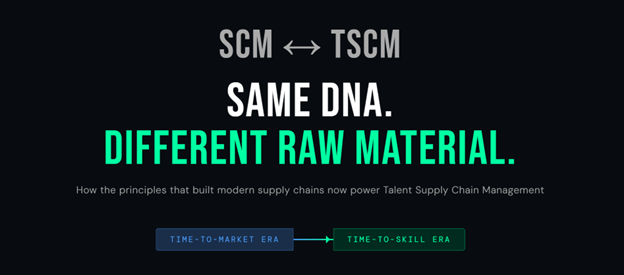
What worked for SCM, will work for TSCM. For decades, companies have optimized how they move products. The ones winning today are optimizing how they move skills. The framework is identical, only the raw material has changed: from goods to Talent.
FREQUENTLY ASKED QUESTIONS
What is Talent Supply Chain Management?
It's applying supply chain principles to your workforce. Instead of scrambling to fill vacancies, you forecast talent needs, build pipelines, and optimize flow, just like you do with products.
How is TSCM different from regular workforce planning?
Traditional planning asks "How many people do we need?" TSCM asks "What capabilities do we need, when, and should we build them or buy them?" It's strategic, not just headcount.
How long does it take to see results?
Most companies see improvements within 90 days:
- Faster hiring decisions
- Better build vs. buy choices
- Fewer "surprise" vacancies
Full transformation takes 6-12 months.
What's "Time-to-Skill" and why does it matter?
It's how long from "we need someone" to "they're fully productive." Most companies don't track this. TSCM makes it visible and helps you reduce it by 30-50%.